

Pulpo á feira
The revenge of an octopus

Pulpo á feira
This is the sworn testimony of those who were present and witnessed the events taking place at 15:30 on Sunday 11th August at O’Faro in Oira Praira, Ourense, Galicia.
Maria, la pulpeira: They come to us because it’s impossible to get octopus fresher than the ones we serve, but what that tourist asked for wasn’t normal. In the 27 years I’ve worked cooking octopus, the last fifteen of those on this very corner, it’s the first time a customer has ever asked for that.
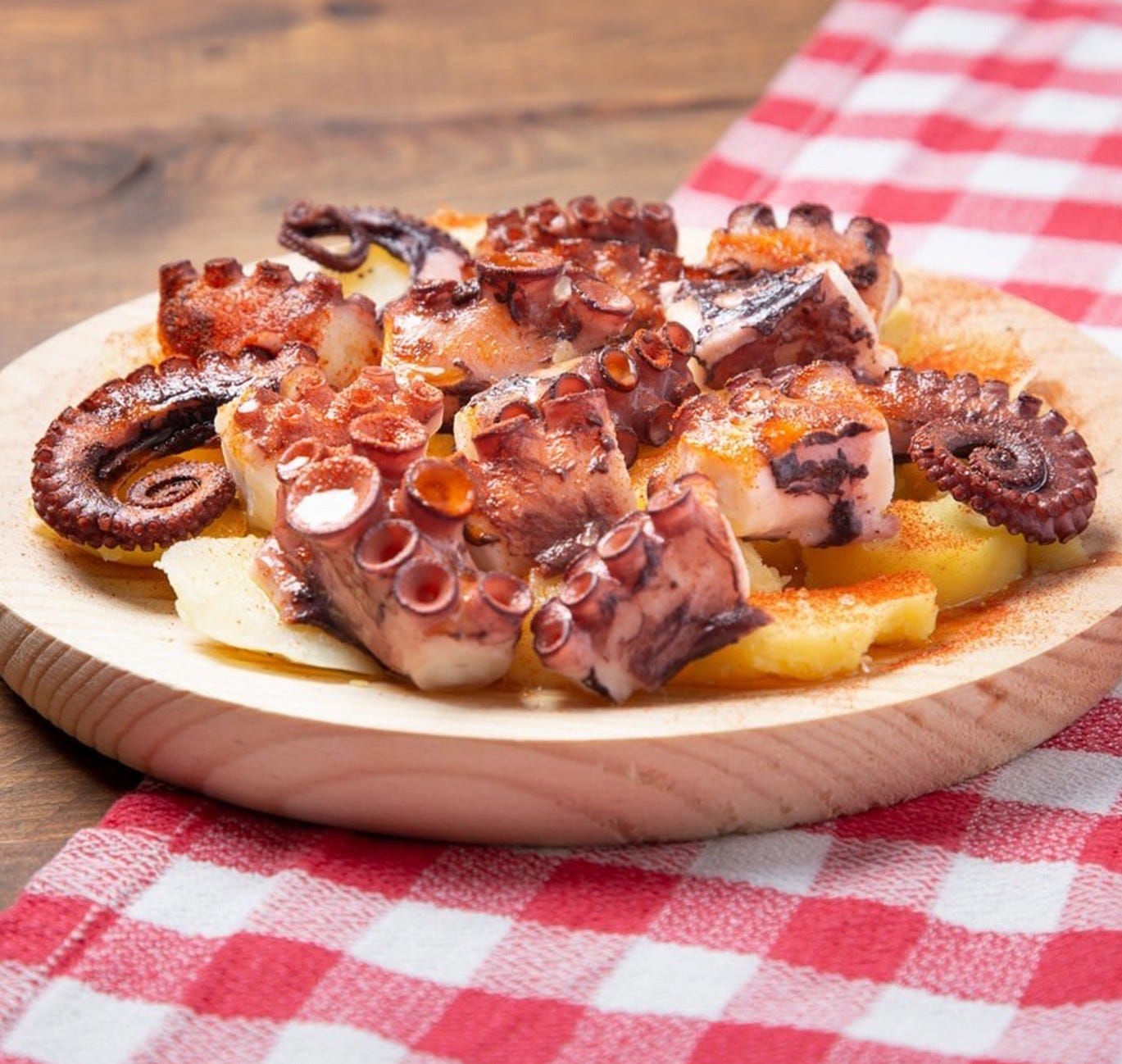
Santiago, the waiter: The foreigner was very disappointed when I told him we only had cheese and cold cuts. We don’t serve much food at O Faro. Mainly drinks, but we have an arrangement on Sundays with the women on the corner across the road selling octopus. We send the customers over there if they are hungry and they come and collect the dishes when they are done. It’s good for business. A lot of people come here to buy octopus from them. Those two have the best reputation in the whole of Galicia. There have even been write-ups in the national press.
Rosa, la pulpeira: The man came over just as we dropped another live one into the boiling water. He watched us taking it out of the bucket and dropping it in the barrel. Fascinated, he was. I remember he was very nervous too. Had some kind of twitch. He didn’t speak our language, either. Fortunately, we’ve both picked up a little bit of English over the years, so we were able to understand the gist of what he wanted. I mean, between the two of us, we managed, but we didn’t comprehend why he’d want us to prepare it in that way.
Santiago: I served him a glass of albariño, and he asked me to leave the bottle. As I was pouring the wine, Maria came over with his food. I was shocked when I saw the octopus was whole and live. Even though it was uncooked, the pulpeira had placed it on the usual wooden dish and had drizzled olive oil on it and sprinkled some coarse sea salt and sweet paprika over it, just like they do when they serve it the traditional way. Pulpo á feira we call it. It was wriggling around on the dish, blinking from its intense black eyes. I swear I could see fear forming within. Or maybe it was rage. I think they can see things we cannot see.
Maria: After he’d asked for a live one, me and Rosa discussed how to serve it, and decided just to prepare it the way we always do, but it was alive, of course. I mean we usually tenderise the animal in boiling water for 30 minutes or so, depending on the size. It’s important not to overcook it. Otherwise, the texture will be rubbery – just as bad as when you cook octopus after it’s frozen. He’d asked for a small one, so we chose what must have been a baby octopus. We always dip the tentacles in and out of the boiling water while holding the live animal by its head, to curl the tips. I asked him if he wanted us to do that, but he said it wasn’t necessary. Some pulpeiros beat the octopus against a hard surface before dropping it in boiling water. They say it breaks the fibres of the meat and makes it more tender, but we think doing that shocks the animal, so we just boil it alive. Of course, in this case, none of that was necessary.
Rosa: Both of us are superstitious. We make a point of apologising to each octopus before we cook it. That comes from early on, when we first started doing this. Maria had terrible nightmares, and I had trouble sleeping. Then one Sunday, years ago, before we started on our corner, we went to church and lit a candle for Saint Architeuthis. He’s the patron saint of the octopus, you know. Back in the 19th century, sailors who were hunting squid and sea serpents began praying to Saint Architeuthis. They swore it saved them from being thrown overboard, or at least led to a less painful and relatively quick death than was otherwise common. Because the octopus was alive when we served it, neither of us apologised or offered any consolation to the creature this time. I think that’s why what happened, happened.
Santiago: I had to stay and watch him eat. Normally, I would never do that with a customer, but I asked him for permission when I saw that octopus wriggling on the dish. He smiled when I asked. I think he wanted an audience.
Rosa: When Santiago asked to stay and watch, I decided to linger too, and I called Maria over. I asked him first if he wanted me to cut the creature up into pieces with my scissors, or at least I asked Santiago to ask him as he speaks better English. That’s the way we serve octopus when it’s cooked, but the man said ‘No’. He was a serious looking man, and once I’d stepped back from the table, he looked down at the creature intensely.
Santiago: The tentacles were writhing around on the wooden plate and the creature fixed him with that intense gaze, no doubt daring him to eat it. I’m convinced the octopus cursed him at that very moment. It’s the only explanation I have for what happened next.
Maria: As I came over, Santiago was topping up the wine in his glass. He sipped the albariño, then picked up the creature with his fingers. I was surprised. I thought he’d use a knife and fork, cut the thing up, but he didn’t. Because the animal was covered in olive oil, it slipped from his hand at first. His fingers were pretty messy, but then he used both hands and pinned the creature down on the plate.
Santiago: The tourist lifted the octopus up to his mouth and then swallowed it whole, stuffing it with difficulty into his mouth, head first. The tentacles were last to be swallowed. I could see the poor thing trying to grasp onto the man’s lips in some kind of desperate attempt to avoid being eaten. The man gulped and I thought that was that. I assumed he’d finished the creature off.
Rosa: The man finished his glass of wine and Santiago poured another from the bottle on the table. He finished that too, then he smacked his lips and closed his eyes, and patted his mouth and wiped his hands with the napkin. He looked very pleased with himself. We all looked at each other, lost for words.
Santiago: I poured him another glass of wine, then I was about to head back to the kitchen but he suddenly grabbed his stomach and started wailing in pain. I touched his shoulder and asked him if he was okay, but he brushed me off and doubled over, holding his stomach. He looked as if he was in agony.
Maria: I thought it was some kind of act at first, that he was putting on a show for our benefit. Not that I wasn’t alarmed when he started acting up, but I was sure he was going to turn back at us and laugh, but that didn’t happen. Instead, the tourist slipped from the metal chair onto the hard ground and started writing about. under the table.
Santiago: I called inside and asked Miguel to call for an ambulance then. it was clear the man was in pain. I must have only turned my head towards the bar for a few seconds, but when I turned back, I understood it was worse than any of us thought.
Rosa: The man rolled over, clasping at his throat. As we watched, I saw, one of the tentacles emerge. The creature must have crawled back up from his stomach back into the man’s mouth. His cheeks were inflated, and I saw protrusions momentarily jutting from within. Once, twice, three times. All the while, the man was choking. Some may say we should have helped the man, then, but we were all too shocked to do so.
Maria: Suddenly, another one of the tentacles emerged from the man’s lips. He kicked out and the wine glass and bottle fell onto the ground. Then another two tentacles grasped onto his lips and the creature’s head popped out.
Santiago: I would have helped him, I swear, but he’d pushed me away when I first offered assistance, so I thought I’d just let him be. Hi legs were kicking and his face turned blue. Then he stopped moving. Finally, the rest of the octopus emerged, its deep dark eyes glaring at us. It ran off then. I’ve never seen an octopus do that, but this one did. Before we knew it, the creature raced out of the bar and down the road, presumably heading towards the sea.
Rosa: That was the last day Maria and set up at the corner across the road from the bar. We are no longer in the octopus business.
‘Pulpo á feira’ was first published in Spanish in Imaginación y mundo interior (2026), issue 5 of Revista Literaria of Literaria Centro Mexicano de Escritores, edited by Rodrigo Murguía.